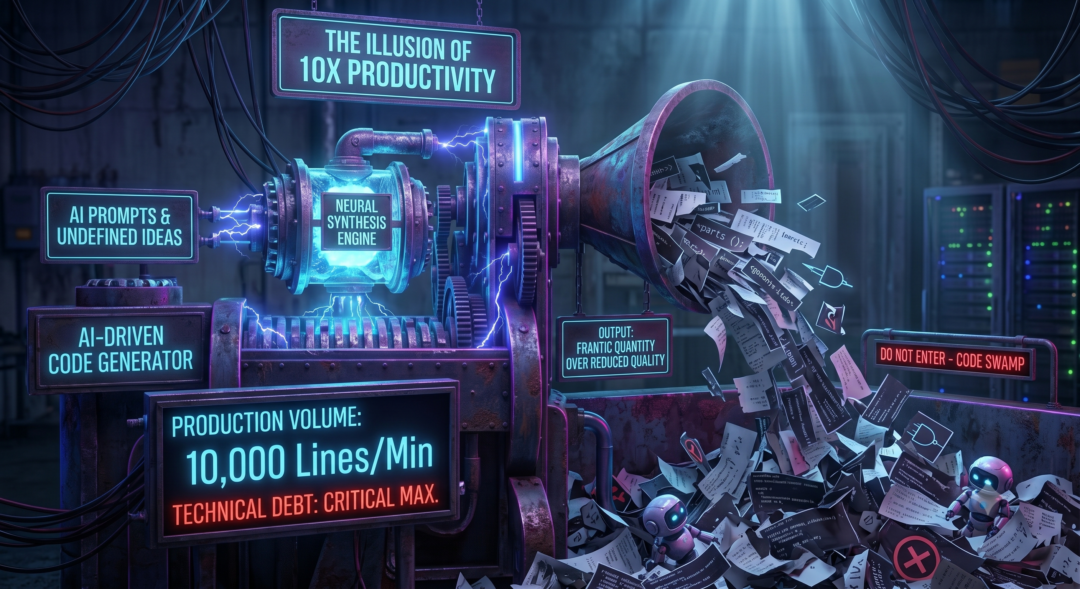
Clean Code Is Dead:
Why AI-Native Architecture Rewards Ugliness
For decades, we optimised software around a dogma: code is written for humans. We used descriptive variable names, docstrings and whitespace. Readability was the goal. In an era when code is primarily written, read and maintained by AI agents, that principle becomes an expensive obstacle.
Welcome to the reality of AI-native architecture.
The Tyranny of the Token
For AI, Clean Code is not a mark of quality; it is noise. The model does not think in lines, but in vectors and tokens. Between them sits the tokenizer, chopping up the text.
Modern tokenizers use byte pair encoding (BPE). Common words are cheap – few tokens – while rare words or long compound words are expensive.
A classic Clean Code example:
retrieve_customer_transaction_history_from_database()The tokenizer splits this into numerous fragments. That costs processing time, money in API charges and, above all, space in the limited context window.
Density Beats Readability
In AI-native architecture, we replace explicitness with density. We optimise for token count.
A comparison illustrates the economics:
- Clean Code (for humans): approximately 110 tokens. Packed with type hints, error messages and descriptive variables (discount_percentage).
- Compact code (for machines): approximately 45 tokens. def calc_dp(p: float, d:float)->float: Dense, cryptic and without whitespace.
The result: AI understands both perfectly. But the second version is more than twice as efficient. It allows the agent to keep more logic in context – in-context learning – without losing its memory.
AST Compression: Strip Off the Tinsel
When agents communicate with one another, or code exists only briefly as ephemeral code, we must be ruthless. We perform manual AST compression (Abstract Syntax Tree):
- Delete comments: They cost money and often cause hallucinations when they diverge from the code – “comment drift”.
- Remove whitespace: JSON needs no indentation. Indentation is wasted space in the context window.
- Enforce brevity:
AuthCtrlinstead ofAuthenticationRequestController. This saves attention in the model’s quadratically scaling attention mechanism.
Conclusion: Alien Artefacts
We are moving towards a world in which code becomes unreadable to humans – optimised for machines and written by machines. This goes against our pride as craftspeople, but is necessary for scaling autonomous agents.
Warning: Do not start merging lambda x: x into your human-maintained codebase. These techniques apply to code processed exclusively by AI. But understand this: in the cloud age, aesthetics are a cost factor.